Claude vs ChatGPT: Which AI Assistant Should You Use? (2026)
Claude vs ChatGPT comes down to fit, not a clear winner. Pick Claude for careful long-form writing, large-document work, and coding; pick ChatGPT for the widest feature set — image and video generation, voice, and a huge plugin ecosystem. Both have solid free tiers, and many people happily use both.
Claude vs ChatGPT is close in 2026. Choose Claude for thoughtful writing, big documents, and coding. Choose ChatGPT for the broadest toolbox — image/video, voice, and integrations. Free tiers cover casual use; $20/month unlocks the strong models on either side. Trying both is cheap and worthwhile.
At a glance
| Claude | ChatGPT | |
|---|---|---|
| Maker | Anthropic | OpenAI |
| Top model (2026) | Opus 4.7 / Sonnet 4.6 | GPT-5.5 / GPT-5.5 Pro |
| Context window | Up to 1M tokens | Up to ~1M tokens |
| Writing quality | Natural, careful tone | Versatile, fast |
| Coding | Top-rated | Strong |
| Image generation | No (reads images) | Yes (built-in) |
| Voice mode | Limited | Mature, real-time |
| Ecosystem | Lean, focused | Large (GPT Store, Sora) |
| Free tier | Yes, capped | Yes, 10 msgs / 5h |
| Paid entry | Pro $20/mo | Plus $20/mo |
Highlighted cell = edge on that row. Not an overall winner — it depends on your workflow.
Both Claude and ChatGPT are excellent in 2026, and for most everyday tasks either one will do the job well. The honest answer to “which is better” is “it depends on what you do most.” This guide walks through the real differences — models, writing, coding, files, pricing, and privacy — so you can pick with confidence.
Claude vs ChatGPT comes down to fit, not a knockout. Choose Claude for careful long-form writing, large-document work, and coding quality. Choose ChatGPT for the broadest toolbox — built-in image and video generation, mature voice, and a large plugin ecosystem. Both have usable free tiers, and running both is a common, affordable setup.
What each one is
Claude is made by Anthropic and focuses on being a careful, capable assistant for writing, analysis, and code. The interface is clean and text-first, with strong support for uploading documents and images. Its models in 2026 are the Opus and Sonnet families.
ChatGPT is made by OpenAI and is the most widely used AI assistant. It bundles a lot into one app: text chat, image generation, the Sora video tool, voice conversations, Deep Research, Agent Mode, and a store of custom GPTs. Its 2026 flagship is the GPT-5.5 series.
The simplest framing: Claude is a focused specialist that does writing and code very well; ChatGPT is a generalist that does a bit of everything in one place.
Models and what powers them
As of mid-2026, Anthropic’s lineup centers on Claude Opus 4.7 (the most capable, released April 2026), Sonnet 4.6 (the balanced everyday model), and Haiku 4.5 (the fast, low-cost option), per Anthropic’s model docs. OpenAI’s lineup is led by GPT-5.5 and GPT-5.5 Pro, which OpenAI introduced in April 2026 as the default frontier model in ChatGPT, with GPT-5.4 still available below it.
Both makers offer a “thinking” or reasoning mode that spends more time on hard problems. In practice the top models from each are close on general tasks; the gaps show up in specific areas covered below, and benchmark leads tend to swap with every release.
Writing quality
This is where many people feel a real difference. Claude is often praised for a more natural, less formulaic tone — it tends to avoid the stock phrasing that makes AI text easy to spot, and it holds a consistent voice across long pieces. If you write essays, articles, or emails and care how they sound, Claude is worth a serious look.
ChatGPT is no slouch and is faster to brainstorm across many formats and angles. It’s also handy when you want the draft plus a matching image or a quick rewrite in another style. For pure prose polish, though, Claude usually edges ahead.
A practical tip: run the same prompt through both and compare. Tone preference is personal, and the only test that matters is which output you’d actually send.
Coding
Claude’s Opus and Sonnet models are widely rated among the strongest for coding in 2026, especially on large, multi-file tasks and refactors. That reputation carries into developer tools — see our take on Claude Code vs Cursor and the wider best AI for coding roundup.
ChatGPT (GPT-5.5) is also strong and pairs well with its Codex tooling and Agent Mode for running tasks. For everyday scripts, debugging, and explanations, both are reliable. If coding is your main use, Claude is a safe default, but the margin is small and either will serve a learner well.
Reasoning, context window, and files
On reasoning — math, logic, multi-step problems — the two trade blows, and the gap is narrow at the top tier. Both perform noticeably better when you turn on their extended-thinking modes.
Context window is the amount of text a model can consider at once. In 2026 both reach roughly 1 million tokens on flagship tiers — Anthropic lists up to 1M for Opus and Sonnet, and OpenAI lists about 1.05M for GPT-5.5 in the API (GPT-5.5 docs). That’s enough to drop in a long report or a sizable codebase, though the very largest contexts may cost more or require higher plans.
Both handle file and image input well:
- Claude: upload PDFs, spreadsheets, and images; it reads and analyzes them. Opus 4.7 added higher-resolution image support.
- ChatGPT: the same document and image reading, plus it can generate images and (via Sora) video, which Claude cannot.
If your work involves summarizing big documents or reasoning over long inputs, both are capable — pick on tone and price. If you need to create visuals, ChatGPT wins outright. To understand how tools feed external data into these models, our what is RAG in AI explainer is a good next read.
Pricing: free and paid tiers
Pricing is close, and the headline plans cost the same on each side. Here’s the consumer picture for individuals in 2026.
Claude (from Claude’s pricing page):
- Free — $0, light daily use with the everyday model.
- Pro — $20/month (about $17 billed annually), more usage and the stronger models.
- Max — $100/month (5x) or $200/month (20x) for heavy users; these are larger usage buckets, not better models.
ChatGPT (from ChatGPT’s pricing page):
- Free — $0, capped at around 10 messages per 5 hours on a recent model.
- Go — about $8/month, a lighter paid tier.
- Plus — $20/month, the full model suite, Deep Research, Sora, voice, and Agent Mode.
- Pro — $200/month for the highest quotas and the Pro-grade model.
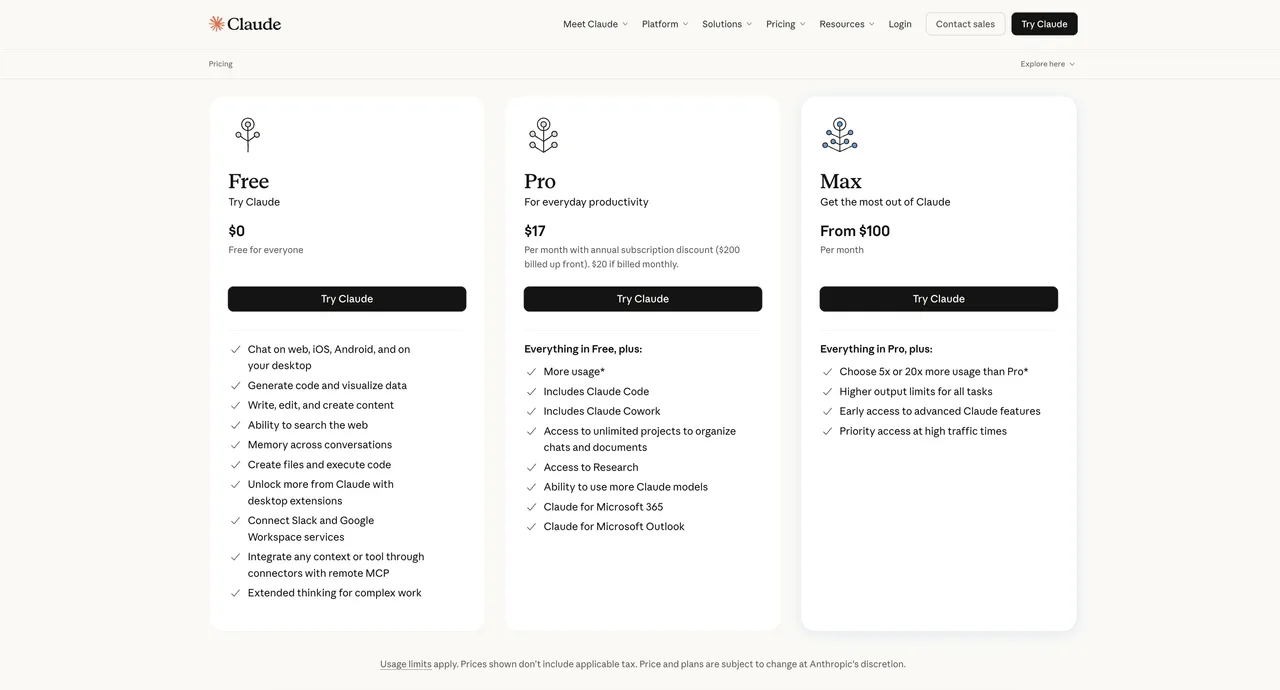
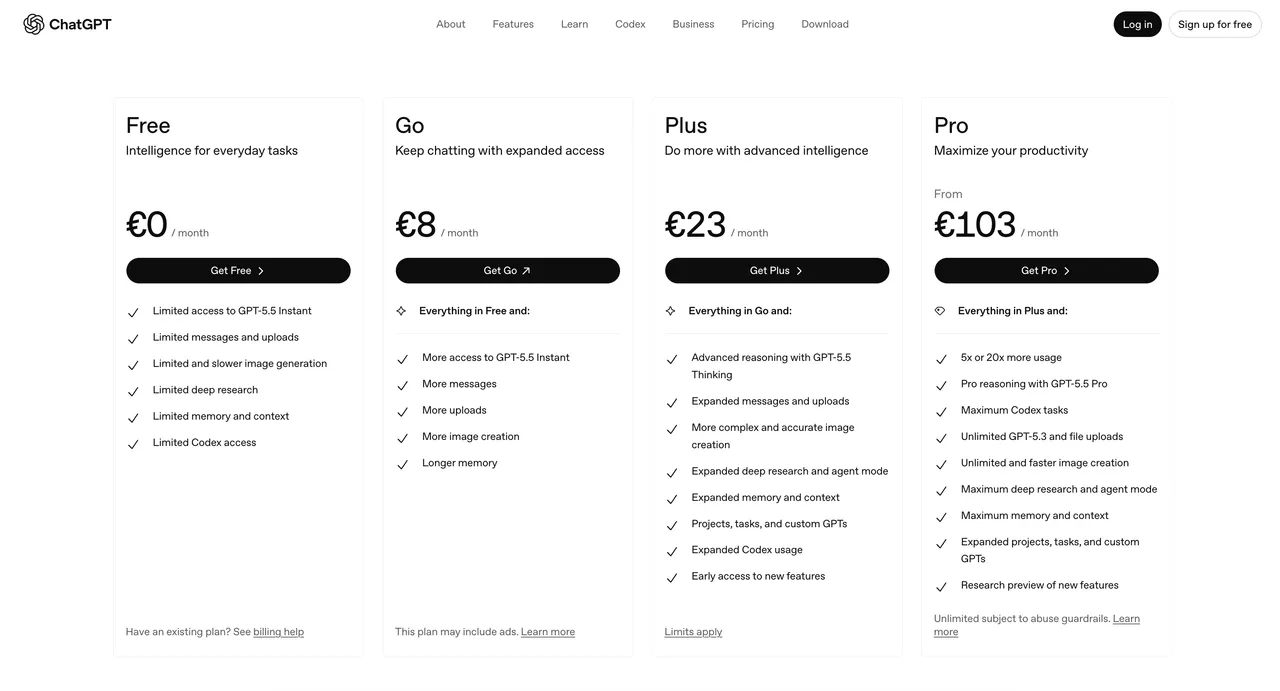
For most people the $20 tier on either side is the sweet spot. If you only chat occasionally, both free tiers are genuinely usable.
Privacy and data
Both companies let you opt out of having your chats used to train their models, and both offer business and enterprise plans with stronger data controls and retention settings. The defaults differ over time, so the practical advice is the same for both: open settings, turn off chat history or model-training if you handle anything sensitive, and check the current data policy on each provider’s site before sharing confidential material. If privacy is your top priority, a tool built around it — like Venice AI, which keeps conversations in your browser — is worth a look, though its models don’t match the frontier labs.
Ecosystem and extras
This is ChatGPT’s clearest advantage. In one subscription you get image generation, Sora video, real-time voice, Deep Research, Agent Mode, and a large store of custom GPTs built by others. If you want a single app that does many things, ChatGPT is hard to beat.
Claude’s ecosystem is leaner by design. It connects to tools through integrations and the Model Context Protocol, and its developer-facing Claude Code is well regarded, but it doesn’t generate images or video and its voice features are limited. Claude bets on doing core text and code tasks extremely well rather than covering every feature.
Can you use both?
Yes — and it’s a sensible setup. Two $20/month plans together cost about the same as a single premium subscription elsewhere, and they cover different strengths. A common split:
- Claude for drafting and editing long-form writing, and for coding help.
- ChatGPT for image and video, voice chats, quick research, and anything that needs a plugin or integration.
There’s no lock-in. You can paste the same prompt into both, keep the better answer, and cancel whichever you use less.
The bottom line
If your days revolve around writing and code, start with Claude. If you want one app that also makes images, video, and handles voice and integrations, start with ChatGPT. Both have free tiers, both cost $20/month to unlock the strong models, and neither choice is a mistake — many people simply use both. Browse our AI tools hub for more comparisons, and subscribe to get our hands-on tests and prompt packs as we publish them.
Which should you choose?
Choose Claude if…
- You write long-form and care about tone
- You work with big documents or codebases
- Coding quality is a priority
- You prefer a calmer, focused interface
Choose ChatGPT if…
- You want image, video, and voice in one app
- You rely on plugins and integrations
- You want the widest feature set
- You like Deep Research and Agent Mode
Frequently asked questions
Is Claude better than ChatGPT?
Neither is universally better. Claude tends to lead on long-form writing quality and coding; ChatGPT leads on breadth — image and video generation, voice, and a large ecosystem. Pick by the tasks you do most.
Which is better for writing, Claude or ChatGPT?
Many writers prefer Claude for a more natural, less generic tone and for handling long documents in one pass. ChatGPT is faster to spin up many drafts and formats. Try the same prompt in both and compare.
Which is better for coding?
Claude's Opus and Sonnet models are widely rated top-tier for coding in 2026, especially on large, multi-file work. ChatGPT (GPT-5.5) is also strong. For a deeper look, see our best AI for coding guide.
Are the free versions good enough?
For casual use, yes. ChatGPT's free tier gives capped access to a recent model; Claude's free tier covers light daily use. Heavy users hit limits and benefit from a $20/month plan on either side.
How big is the context window?
In 2026 both reach around 1 million tokens on their flagship tiers — roughly a large book of text. That lets you paste long documents or whole codebases, though very long inputs can cost more or need higher plans.
Which is more private?
Both let you turn off training on your chats in settings, and both offer business tiers with stronger data controls. For sensitive work, disable chat history/training and check the current data policy on each provider's site.
Can I use Claude and ChatGPT together?
Yes, and many people do — Claude for careful writing and coding, ChatGPT for image/video, voice, and integrations. Two $20 plans cost about the same as one premium subscription elsewhere.
Which should a beginner start with?
ChatGPT is the easiest first stop thanks to its all-in-one features and huge community. If your main jobs are writing and coding, start with Claude. You can switch or run both at no real risk.
Keep reading


Get good at AI — one practical email a week.
Tools, use cases, and shortcuts you can actually apply. No hype.