What Is RAG in AI? (Retrieval-Augmented Generation, Explained Simply)
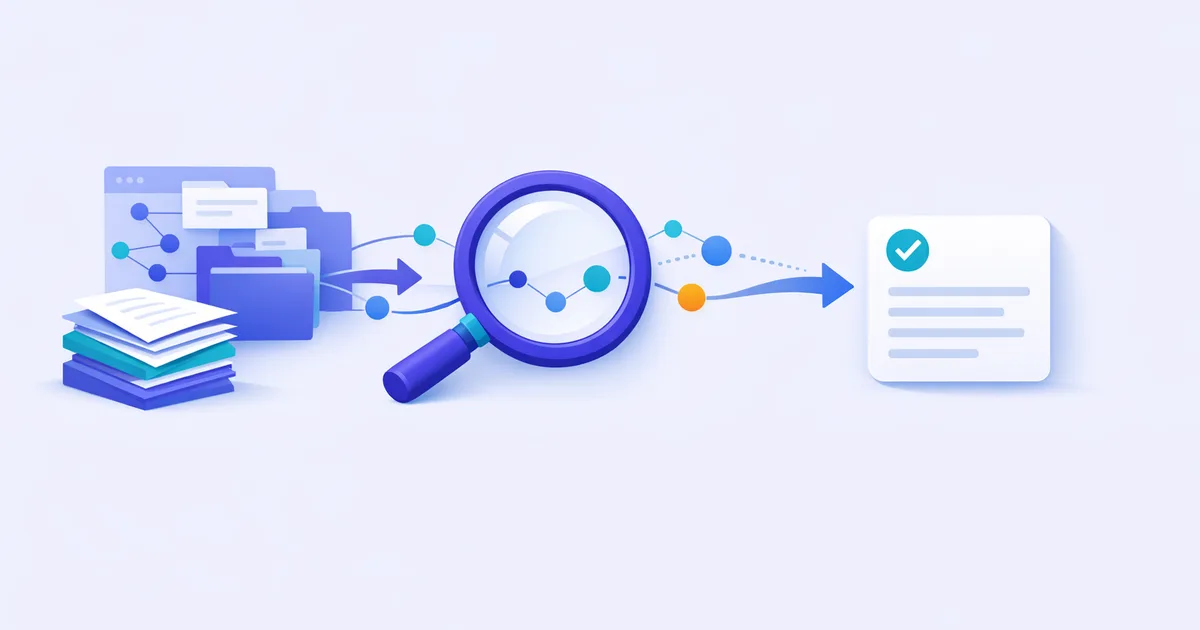
RAG (Retrieval-Augmented Generation) is a method where an AI model first retrieves relevant information from an external source — like a company’s documents or a database — and then uses that information to generate its answer. Instead of relying only on what it memorized during training, the model “looks things up” first. This makes answers more accurate, up to date, and grounded in your specific data.
If you’ve ever asked a chatbot a question and it confidently made something up, you’ve seen the problem RAG solves. Large language models (LLMs) only know what they were trained on, and that knowledge is frozen and general. RAG fixes this by letting the model consult real, relevant sources before it answers.
RAG in simple terms
Think of the difference between a closed-book exam and an open-book exam. A standard LLM takes a closed-book exam — it answers from memory alone, which is why it sometimes guesses or invents facts. RAG turns it into an open-book exam: before answering, the AI opens the “book” (your documents, a knowledge base, the web), finds the relevant pages, and writes its answer based on what it just read.
The model still does the writing — but now it’s writing from sourced material instead of memory.
How RAG works
RAG happens in three steps, every time you ask a question:
- Retrieve. Your question is used to search an external knowledge source (documents, a database, a website). The system pulls the most relevant pieces of text — often using a vector database that finds passages by meaning, not just keywords.
- Augment. Those retrieved passages are added to your question and handed to the LLM as extra context — essentially: “Here’s the question, and here’s relevant information to answer it.”
- Generate. The LLM writes an answer grounded in the retrieved information, often citing or quoting the sources.
Why RAG matters
RAG solves three real limitations of standalone LLMs:
- Reduces hallucinations. Grounding answers in retrieved facts makes the model far less likely to invent things.
- Adds fresh and private knowledge. A model trained last year doesn’t know your latest docs or this week’s news. RAG lets it answer from current, internal, or proprietary information without retraining.
- Makes answers verifiable. Because answers come from specific sources, they can cite where the information came from — building trust.
This is why most business AI assistants — customer support bots, internal “ask our docs” tools, research assistants — are built with RAG.
RAG vs fine-tuning
People often confuse RAG with fine-tuning. They solve different problems:
| RAG | Fine-tuning | |
|---|---|---|
| What it does | Gives the model knowledge to look up at answer time | Teaches the model new behavior/style during training |
| Updating info | Easy — just update the documents | Hard — requires retraining |
| Best for | Factual, changing, or private data | Tone, format, specialized skills |
| Cost to maintain | Low | Higher |
In practice, many systems use both: fine-tuning for how the model responds, RAG for what it knows.
Real-world examples
- A customer-support bot that answers from your help center and product docs.
- An internal “ask our company” assistant that searches policies, wikis, and past tickets.
- A research tool that pulls from a library of papers and cites them.
- A search experience that summarizes results with sources (like AI Overviews).
Is RAG still needed with long context windows?
Modern models can read very long inputs, so why not just paste everything in? Because it’s expensive, slow, and doesn’t scale — you can’t fit an entire company’s knowledge into one prompt, and you’d pay for it on every query. RAG retrieves only the relevant slice, which is cheaper, faster, and more accurate. Long context and RAG are complementary, not competing.
Frequently asked questions
What does RAG stand for? RAG stands for Retrieval-Augmented Generation — an AI method that retrieves relevant information before generating an answer.
How does RAG work? In three steps: retrieve relevant text from an external source, augment the prompt with that text, and generate an answer grounded in it.
Why is RAG used? To reduce hallucinations, give models access to fresh or private data without retraining, and make answers verifiable by grounding them in real sources.
What’s the difference between RAG and fine-tuning? RAG gives the model knowledge to look up at answer time and is easy to update; fine-tuning changes the model’s behavior or style during training and is harder to update. They’re often used together.
Is RAG still needed with large context windows? Yes. Pasting everything into a long prompt is costly, slow, and doesn’t scale. RAG retrieves only the relevant information, which is cheaper, faster, and more accurate.
What’s a simple example of RAG? A support chatbot that searches your help docs for the relevant article, then writes an answer based on it — instead of guessing from memory.
Want the rest of the AI vocabulary? See our explainers on what an LLM is, generative AI, and AI agents — and how RAG powers AI automation.
Keep reading
Get good at AI — one practical email a week.
Tools, use cases, and shortcuts you can actually apply. No hype.