How Much Water Does AI Use? (The Real Numbers, Explained)
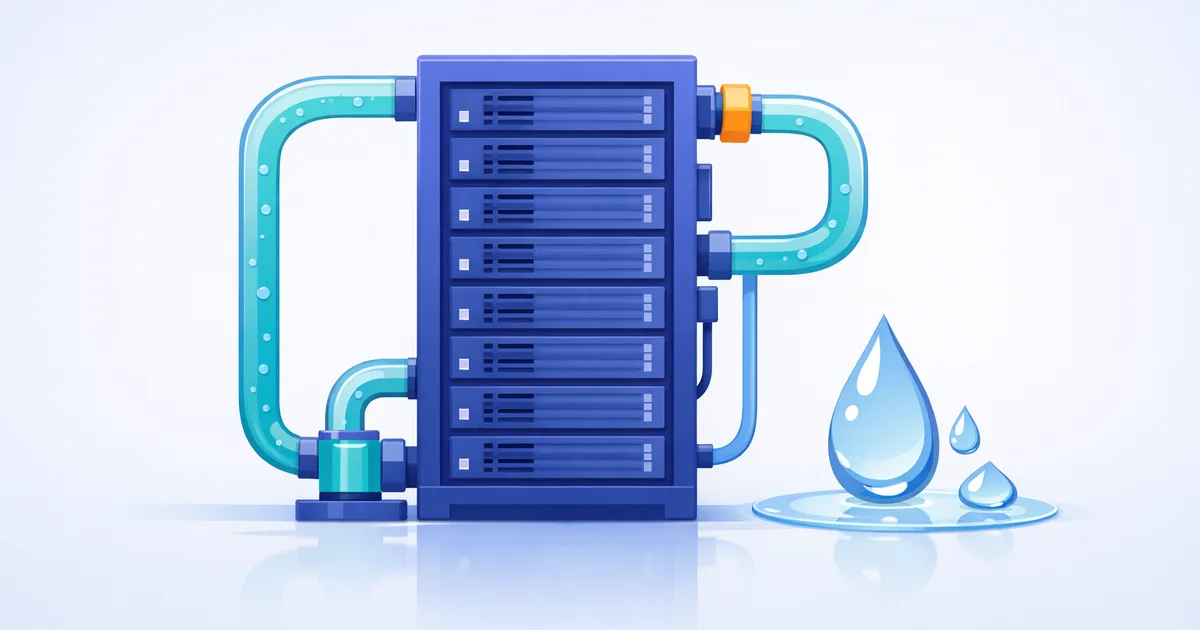
AI's water use depends on what you count. A single ChatGPT-style query uses roughly 0.3 ml to 50 ml of water across cooling and power generation, per published estimates. A big data center can use millions of gallons a year, mostly to cool its servers.
You’ve probably seen the scary headlines: “ChatGPT drinks a bottle of water every time you talk to it.” The truth is more interesting and a lot less alarming. AI’s water use is real, the numbers vary widely depending on what’s measured, and the honest answer needs a bit of context. Here’s a clear, sourced look at where the water actually goes.
Why does AI use water at all?
AI doesn’t drink water like you do. It uses water indirectly, in two main ways.
- Direct cooling. AI runs on racks of servers packed into data centers. Those chips get hot, and many data centers use water to carry that heat away, often by evaporating it in cooling towers. Evaporated water leaves the system, so it counts as “consumed.”
- Indirect, through electricity. Data centers draw huge amounts of power, and many power plants (especially coal, gas, and nuclear) consume water to make that electricity. This indirect water often dwarfs the direct cooling water.
Researchers split these into “scope-1” (on-site cooling) and “scope-2” (off-site power generation). When you see two very different water numbers for AI, it’s usually because one counts only scope-1 and the other counts both. That single distinction explains most of the confusion in the headlines.
How much water does one ChatGPT query use?
This is the question everyone asks, and the answer is a range, not a single number.
The widely cited figure comes from a University of California, Riverside study, Making AI Less “Thirsty,” which estimated that GPT-3 consumes a 500 ml bottle of water for roughly 10 to 50 medium-length responses (UC Riverside / CACM, 2025). That works out to roughly 10–50 ml per query, and it includes both on-site cooling and power-plant water.
In 2025, OpenAI’s Sam Altman published a much smaller figure: about 0.000085 gallons (≈0.32 ml) per average query — roughly one-fifteenth of a teaspoon (Data Center Dynamics, 2025). That number is not peer-reviewed, the definition of an “average query” is unclear, and it appears to count mostly on-site water. So the two figures aren’t really contradicting each other; they’re measuring different things in different years on different hardware.
The honest takeaway: estimates span from a fraction of a teaspoon to a few tablespoons per query, and they vary with the model, the data center’s location, the local climate, and how the electricity is made.
The numbers in one table
Here are the most-cited figures, with the source and year so you can check them yourself.
| What | Estimated water use | Source (year) |
|---|---|---|
| One ChatGPT/GPT-3 query (cooling + power) | ~10–50 ml (500 ml per 10–50 responses) | UC Riverside / CACM (2025) |
| One “average” ChatGPT query (OpenAI’s figure) | ~0.32 ml (0.000085 gal) | Data Center Dynamics (2025) |
| Training GPT-3 (Microsoft U.S. data centers) | ~5.4 million liters total | UC Riverside / CACM (2025) |
| Google data centers, total (2024) | ~8.1 billion gallons | Data Centre Magazine / Google Env. Report (2025) |
| Google, single largest site (Council Bluffs, IA, 2024) | ~1 billion gallons | Data Centre Magazine (2025) |
| U.S. data centers, direct cooling (2023) | ~17 billion gallons | EESI / LBNL report (2024) |
| U.S. data centers, indirect via electricity (2023) | ~211 billion gallons | EESI / LBNL report (2024) |
| Global AI water withdrawal, projected (2027) | 4.2–6.6 billion cubic meters | UC Riverside / CACM (2025) |
The big spread between per-query estimates is exactly why you should treat any single viral statistic with caution. Numbers from different studies measure different boundaries.
How much water does generating an AI image use?
You may have seen claims that one AI image costs gallons of water. There isn’t a solid, peer-reviewed per-image water figure to back the largest of those claims, so be skeptical of exact gallon counts.
What we do know: a Hugging Face and Carnegie Mellon study found that generating an image is the most energy-intensive common AI task, roughly equivalent to charging a smartphone (MIT Technology Review, 2023). Since water use tracks energy use (more power means more cooling and more power-plant water), an image generally costs more water than a short text reply, but the precise figure depends heavily on the model and where it runs. The safe statement is “more than a text query, less than the alarmist headlines.”
How much water do data centers use overall?
This is where the numbers get large, because data centers run thousands of AI and non-AI workloads at once.
A Lawrence Berkeley National Laboratory report, commissioned by the U.S. Department of Energy, found that in 2023 U.S. data centers used about 17 billion gallons of water directly for cooling, plus an estimated 211 billion gallons indirectly through the electricity they consumed (EESI / LBNL, 2024). Direct cooling use is projected to climb to 38–73 billion gallons by 2028.
Individual companies are starting to disclose more. Google’s data centers used about 8.1 billion gallons of water in 2024, up from roughly 4.3 billion gallons in 2021 (Data Centre Magazine, 2025). The trend is clearly upward as AI workloads grow. If you want more figures like these, our AI statistics page tracks the headline numbers as they’re updated.
How does AI water use compare to everyday things?
Context matters, so here’s how a single query stacks up against ordinary water costs.
- One ChatGPT query: a fraction of a teaspoon to a few tablespoons.
- One beef burger: roughly 1,700 liters of water to produce, mostly for feed and the animal.
- One cotton t-shirt: about 2,700 liters from crop to finished garment.
- A 10-minute shower: roughly 75–100 liters.
On a per-use basis, your chatbot habit is tiny next to your lunch or your laundry. The reason AI water use gets attention isn’t the per-query number; it’s the scale (billions of queries) and the concentration (many data centers cluster in dry regions where every gallon counts locally).
So how worried should you be?
Balanced answer: per query, the impact is small. The legitimate concern is concentration and growth. When dozens of large data centers cluster in a drought-prone county, their combined draw can strain a local water supply even if each query is trivial. Global AI water withdrawal is projected to hit 4.2–6.6 billion cubic meters by 2027 (UC Riverside / CACM, 2025), so the aggregate trend is worth watching.
It’s also worth noting that smarter system design can cut the cost. Techniques that make AI more efficient — better hardware use, and retrieval methods like RAG that reduce wasted computation — chip away at the energy and water bill. Efficiency and water are linked: less compute means less heat to cool and less power to generate.
What are tech companies doing about it?
The major operators have all announced water programs. Common approaches include:
- Recycled and non-potable water for cooling, so they’re not drawing on drinking-water supplies.
- Air cooling and liquid (chip-level) cooling that reduce or eliminate evaporative loss.
- Siting in cooler climates where less cooling is needed year-round.
- “Water positive” pledges to replenish more water than they consume.
For example, Google reported replenishing about 64% of its freshwater consumption in 2024, with a goal of 120% by 2030 (Data Centre Magazine, 2025). Microsoft has built water-reuse utilities at some sites and reports replenishing over 100 million cubic meters of water (Cloud Computing News, 2025). These pledges are encouraging, but transparency is still patchy — many companies don’t break out water use site by site, which makes independent checking hard.
The bottom line
AI uses water, but the per-query cost is small (a fraction of a teaspoon to a few tablespoons, depending on what’s counted) and far below everyday things like food and clothing. The real story is at the data center level, where cooling and electricity add up to billions of gallons and where local strain in dry regions is a genuine issue. Watch the aggregate trend, support transparency and efficiency, and skip the viral panic. If you want to understand the technology behind these numbers, start with our learn hub.
Frequently asked questions
How much water does one ChatGPT query use? Estimates range from about 0.32 ml (OpenAI’s on-site-only figure) to roughly 10–50 ml per query when you also count the water used to generate the electricity. The UC Riverside study found one 500 ml bottle covers about 10–50 medium responses.
Why does AI use water at all? AI runs on servers in data centers that get hot. Many centers use water for cooling, often via evaporation, and the power plants supplying their electricity also consume water. So AI’s water footprint is part direct cooling, part indirect power generation.
How much water does generating an AI image use? There’s no single peer-reviewed per-image water figure. Image generation is the most energy-intensive common AI task (Hugging Face, 2023), and more energy generally means more cooling and power-plant water, so an image typically costs more water than a short text reply.
How much water do data centers use overall? U.S. data centers directly used about 17 billion gallons for cooling in 2023, plus an estimated 211 billion gallons indirectly through electricity, per a Lawrence Berkeley National Laboratory report. Direct use could reach 38–73 billion gallons by 2028.
Is AI’s water use a serious problem? Per query it’s tiny. At scale, and in drought-prone regions where data centers cluster, local strain is real. The concern is concentration and growth, not your individual chatbot use. It’s worth watching, not panicking over.
How does AI water use compare to everyday things? A single query is a fraction of a teaspoon to a few tablespoons. By comparison, one beef burger takes roughly 1,700 liters of water to produce, and a cotton t-shirt about 2,700 liters. AI’s per-use footprint is small next to food and clothing.
What are tech companies doing about it? Companies are using recycled and non-potable water, air and liquid cooling, building in cooler climates, and pledging to be “water positive.” Google replenished about 64% of its freshwater use in 2024 and aims for 120% by 2030.
Does AI training use more water than everyday use? Training is a one-time, intensive cost. Researchers estimated training GPT-3 in Microsoft’s U.S. data centers consumed about 5.4 million liters of water. Day-to-day queries add up across billions of uses, so both matter at scale.
Want clear, sourced explainers like this in your inbox? Subscribe to our weekly AI digest. For more numbers, see our AI statistics page, and to understand the tech, start at the learn hub.
Frequently asked questions
How much water does one ChatGPT query use?
Estimates range from about 0.32 ml (OpenAI's on-site-only figure) to roughly 10–50 ml per query when you also count the water used to generate the electricity. The UC Riverside study found one 500 ml bottle covers about 10–50 medium responses.
Why does AI use water at all?
AI runs on servers in data centers that get hot. Many centers use water for cooling, often via evaporation, and the power plants supplying their electricity also consume water. So AI's water footprint is part direct cooling, part indirect power generation.
How much water does generating an AI image use?
There's no single peer-reviewed per-image water figure. Image generation is the most energy-intensive common AI task (Hugging Face, 2023), and more energy generally means more cooling and power-plant water, so an image typically costs more water than a short text reply.
How much water do data centers use overall?
U.S. data centers directly used about 17 billion gallons for cooling in 2023, plus an estimated 211 billion gallons indirectly through electricity, per a Lawrence Berkeley National Laboratory report. Direct use could reach 38–73 billion gallons by 2028.
Is AI's water use a serious problem?
Per query it's tiny. At scale, and in drought-prone regions where data centers cluster, local strain is real. The concern is concentration and growth, not your individual chatbot use. It's worth watching, not panicking over.
How does AI water use compare to everyday things?
A single query is a fraction of a teaspoon to a few tablespoons. By comparison, one beef burger takes roughly 1,700 liters of water to produce, and a cotton t-shirt about 2,700 liters. AI's per-use footprint is small next to food and clothing.
What are tech companies doing about it?
Companies are using recycled and non-potable water, air and liquid cooling, building in cooler climates, and pledging to be 'water positive.' Google replenished about 64% of its freshwater use in 2024 and aims for 120% by 2030.
Does AI training use more water than everyday use?
Training is a one-time, intensive cost. Researchers estimated training GPT-3 in Microsoft's U.S. data centers consumed about 5.4 million liters of water. Day-to-day queries add up across billions of uses, so both matter at scale.
Keep reading
Get good at AI — one practical email a week.
Tools, use cases, and shortcuts you can actually apply. No hype.