How Much Energy Does AI Use? (The Real Numbers, Explained)
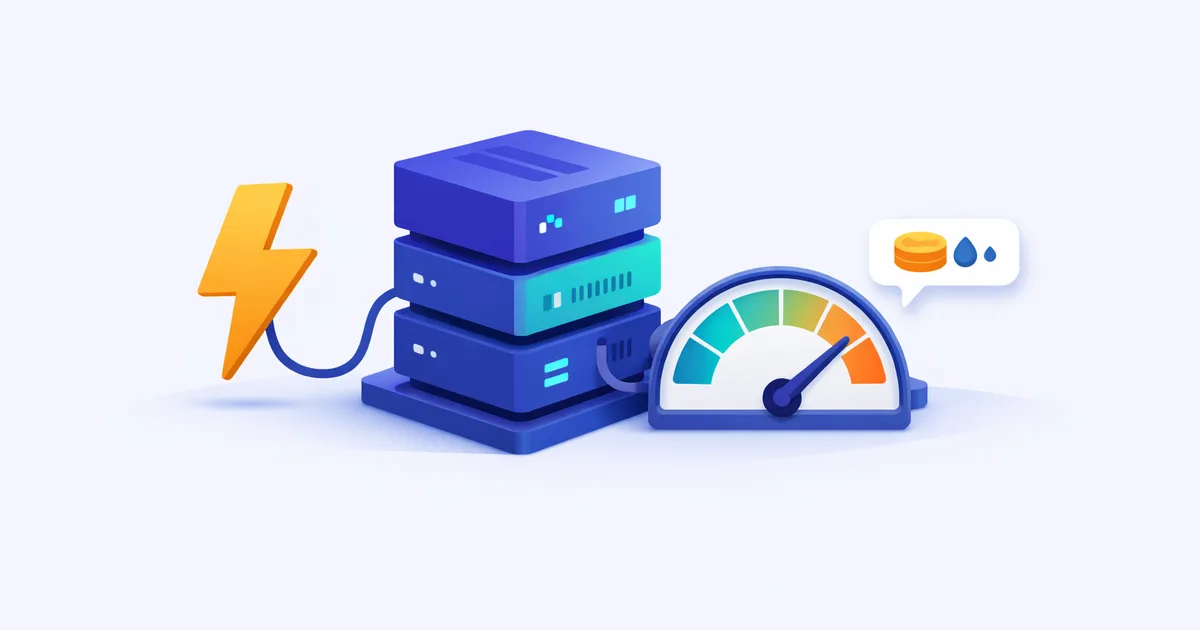
A typical ChatGPT query uses roughly 0.3 watt-hours of electricity — about what an oven draws in one second — per OpenAI and independent estimates. At the grid level, U.S. data centers used about 176 TWh in 2023, around 4.4% of national electricity, and that share is growing fast.
You’ve probably heard that every ChatGPT question “burns ten times the energy of a Google search,” or that AI will swallow the power grid. The honest picture is more nuanced: the per-query cost is small and shrinking, while the total demand from data centers is large and growing. Both things are true at once, and the numbers only make sense with sources attached. Here they are — and if you’re curious about the other half of AI’s footprint, we’ve done the same exercise for water use.
Why does AI use energy at all?
AI’s electricity bill comes from two distinct activities, and mixing them up causes most of the confusion.
- Training is the one-time process of building a model. Thousands of specialized chips run flat-out for weeks or months, which is why training costs are quoted in megawatt-hours or gigawatt-hours.
- Inference is everyday use — every chat reply, image, or summary. Each request is cheap, but popular models serve billions of them, so inference now dominates the running total for deployed systems.
- Overhead sits on top of both: cooling, networking, and power conversion in the data center, usually captured in a metric called PUE (power usage effectiveness).
When you see wildly different “AI energy” numbers, check which of these the figure covers. A per-query estimate that ignores cooling, or a training total presented as if it recurs daily, will mislead you in opposite directions.
How much energy does one ChatGPT query use?
The headline figure comes from OpenAI itself. In June 2025, Sam Altman wrote that the average ChatGPT query uses about 0.34 watt-hours — “about what an oven would use in a little over one second, or a high-efficiency lightbulb would use in a couple of minutes” (Data Center Dynamics, 2025).
That figure isn’t peer-reviewed, and OpenAI didn’t publish its methodology. But it lines up with independent work. The research group Epoch AI estimated a typical GPT-4o query at roughly 0.3 Wh, based on realistic assumptions about response length, modern H100 chips, and actual (not peak) power draw (Epoch AI, 2025). Google went further and published a technical paper: the median Gemini text prompt used 0.24 Wh as of mid-2025 (Google Cloud, 2025).
Two caveats keep this honest:
- The old “3 Wh” estimate wasn’t crazy — it was dated. A widely cited 2023 calculation assumed long responses on older A100 chips running at peak power. Epoch’s revision found each assumption inflated the number, for a combined ~10x overestimate (Epoch AI, 2025; TechCrunch, 2025).
- Not all queries are typical. Epoch notes a 10,000-token document pushes a query to ~2.5 Wh, a 100,000-token input to ~40 Wh, and reasoning models that “think” before answering generate several times more tokens per request. Image and video generation cost more still — a Hugging Face study found image generation is the most energy-hungry common AI task (MIT Technology Review, 2023).
So the defensible answer: a few tenths of a watt-hour for a normal text query, with heavy tasks running 10–100x that.
The numbers in one table
Here are the most-cited figures with sources and years, so you can check them yourself.
| What | Estimated energy use | Source (year) |
|---|---|---|
| One “average” ChatGPT query (OpenAI’s figure) | ~0.34 Wh | Sam Altman via DCD (2025) |
| Typical GPT-4o query (independent estimate) | ~0.3 Wh | Epoch AI (2025) |
| Median Gemini text prompt | ~0.24 Wh | Google (2025) |
| Older per-query estimate (since revised) | ~3 Wh | Epoch AI / TechCrunch (2025) |
| One Google search (dated official figure) | ~0.3 Wh | Google (2009) |
| Streaming 1 hour of video | ~77 Wh (0.077 kWh) | IEA (2020) |
| Training GPT-3 (one-time) | ~1,287 MWh | Patterson et al. (2021) |
| Training a GPT-4-class model (one-time) | ~20–25 MW for ~3 months (≈40–50 GWh) | Epoch AI (2025) |
| U.S. data centers, total (2023) | ~176 TWh (4.4% of U.S. electricity) | LBNL / DOE (2024) |
| U.S. data centers, projected (2028) | 325–580 TWh (6.7–12%) | LBNL / DOE (2024) |
| Global data centres, total (2024) | ~415 TWh (~1.5% of world electricity) | IEA (2025) |
| Global data centres, projected (2030) | ~945 TWh | IEA (2025) |
Note the boundaries: per-query figures cover text chat only, and data-center totals include everything those buildings do — streaming, banking, email — not just AI.
Training vs. inference: which costs more?
Training grabs headlines because the single number is big. Researchers put training GPT-3 at about 1,287 MWh — roughly the annual electricity of 120 U.S. homes (Patterson et al., 2021). For a GPT-4-class frontier model, Epoch AI estimates training drew around 20–25 megawatts continuously for about three months — on the order of 40–50 GWh, or the power of roughly 20,000 American homes for that period (Epoch AI, 2025).
But training happens once. Inference happens billions of times a day. At ChatGPT’s scale, even 0.34 Wh per query adds up to hundreds of megawatt-hours daily, so the lifetime energy of a popular model is dominated by serving it, not building it. That’s why the per-query number — small as it is — matters more for the long-run total than any training headline.
How much electricity do data centers use overall?
This is where the numbers get big, and where the legitimate concern lives.
A Lawrence Berkeley National Laboratory report commissioned by the U.S. Department of Energy found U.S. data centers consumed about 176 TWh in 2023 — 4.4% of national electricity — and projects 325–580 TWh by 2028, or 6.7–12% of U.S. electricity (LBNL / DOE, 2024). Growth accelerated from ~7% a year (2014–2018) to 18% a year (2018–2023), largely because of AI servers.
Globally, the International Energy Agency’s Energy and AI report puts data centres at about 415 TWh in 2024 (~1.5% of world electricity), more than doubling to around 945 TWh by 2030 — slightly more than Japan’s entire electricity use today — with AI the biggest driver and the U.S. and China accounting for nearly 80% of the growth (IEA, 2025).
One caution cuts both ways: these are projections, not measurements, and data centers also run plenty of non-AI work. We track the headline figures as they update on our AI statistics page.
How does AI energy use compare to everyday things?
Context turns watt-hours into intuition. One typical text query (~0.3 Wh) is:
- About 1 second of your oven running, by OpenAI’s own comparison (DCD, 2025).
- A couple of minutes of an LED bulb (a 10 W bulb uses 0.3 Wh in about two minutes).
- Roughly equal to one Google search, at least by Google’s dated 2009 figure of ~0.3 Wh (Google, 2009). The viral “10x a Google search” claim divided an old, high AI estimate by this equally old search figure — neither number holds today.
- About 1/250th of an hour of streaming video, which runs ~77 Wh per hour (IEA, 2020).
- Far less than charging your phone (~10–15 Wh), though generating a single AI image can approach that (MIT Technology Review, 2023).
In short: your chatbot habit is a rounding error in your personal energy footprint. The story isn’t your usage — it’s everyone’s usage combined, concentrated in specific places on the grid.
Why energy per query keeps falling
The per-query numbers above are already out of date in one direction: down. Google reported that the energy of its median Gemini text prompt fell 33x in a single year, driven mostly by software — better model architectures, smarter request batching, and higher hardware utilization (Google Cloud, 2025). Each new chip generation also delivers more computation per watt, and techniques like mixture-of-experts models activate only a fraction of a model’s parameters per request.
The catch is a familiar one from economics: when something gets cheaper, people use more of it. Falling cost per token is exactly what enables reasoning models, longer contexts, and AI video — which use far more tokens per task. Efficiency per query improves while total demand still climbs. That’s not a contradiction; it’s the pattern the LBNL and IEA forecasts already assume.
So how worried should you be?
Balanced answer: skip the per-query guilt, watch the grid-level trend.
Per query, the cost is genuinely small — comparable to a search, a fraction of a minute of streaming. Refusing to use a chatbot to “save energy” is like skipping one elevator ride to fight climate change.
At the system level, the concerns are real but specific. Data centers cluster in particular regions, where they can strain local grids, raise electricity prices, and — if new demand is met with gas instead of clean power — slow emissions cuts. The IEA also notes the flip side: AI applied to grids, buildings, and industry could save more energy than data centres consume, though that outcome isn’t guaranteed (IEA, 2025). Energy and water footprints rise and fall together here: less compute means less power and less cooling.
What’s being done about it?
The pressure is producing visible responses across the industry.
- Clean-power deals at unusual scale. Microsoft signed a 20-year agreement to restart a Three Mile Island reactor — 835 MW of carbon-free power for its data centers, expected online in 2028 (Utility Dive, 2024). Google and Amazon have made similar nuclear and renewable commitments.
- Renewables built for data centres. The IEA projects over 450 TWh of new renewable generation to serve data-centre demand by 2035 (IEA, 2025).
- Efficiency as a product goal. Custom chips (TPUs, inference accelerators), liquid cooling, and model-level tricks like distillation and quantization all cut watt-hours per token.
- More transparency. Google’s 2025 per-prompt paper was the first detailed public measurement from a major provider; OpenAI followed with its own figure. Independent verification is still thin, but the direction is right.
The bottom line
How much energy does AI use? About 0.3 watt-hours for a typical text query — trivial on its own — and about 415 TWh a year for the world’s data centres, heading toward roughly double that by 2030. The per-use number is small and falling; the aggregate number is large and rising. Both deserve to be quoted with their sources, and neither supports panic or complacency. If you want to understand the technology behind these numbers, start at our learn hub.
Frequently asked questions
How much energy does one ChatGPT query use? About 0.3–0.34 watt-hours for a typical text query, per OpenAI’s own figure and an independent Epoch AI estimate. That’s roughly a few minutes of an LED bulb. Long documents and reasoning models can push a single request to several watt-hours or more.
Does training an AI model use more energy than running it? Training is a huge one-time cost — GPT-3 took about 1,287 MWh, and a GPT-4-class model roughly 40–50 GWh by Epoch AI’s estimate. But billions of daily queries mean inference (everyday use) now adds up to more total energy than training for popular models.
How much electricity do data centers use overall? U.S. data centers used about 176 TWh in 2023 — 4.4% of national electricity — per a Lawrence Berkeley National Laboratory report, with projections of 325–580 TWh by 2028. Globally, the IEA puts 2024 data-centre use at about 415 TWh, doubling to ~945 TWh by 2030.
Is a ChatGPT query worse than a Google search? They’re now in the same ballpark. Google’s 2009 figure for a search was about 0.3 Wh — the same as today’s ChatGPT estimates. The popular “10x worse” claim compared an old 3 Wh AI estimate against that dated search figure, and both numbers have since moved.
How does AI energy use compare to streaming video? Streaming an hour of video uses roughly 0.077 kWh (77 Wh), per IEA analysis — about 250 typical ChatGPT queries’ worth. A single AI query is closer to a few seconds of TV time than to a Netflix binge.
Why is AI’s energy use falling per query? Better chips, smarter model designs, and higher utilization. Google reported a 33x drop in energy per median Gemini text prompt in one year. The catch: total demand still rises because usage grows faster than efficiency improves.
Is AI’s energy use a serious problem? Per query, no — it’s tiny. The real issue is aggregate growth: data centers could reach 6.7–12% of U.S. electricity by 2028, straining local grids and slowing emissions cuts if new demand is met with fossil fuels. It’s worth watching, not panicking over.
What are tech companies doing about AI energy use? Buying clean power at scale — Microsoft signed a 20-year deal to restart a Three Mile Island reactor (835 MW), and the IEA projects 450+ TWh of new renewables for data centres by 2035 — plus building more efficient chips, models, and cooling.
Want clear, sourced explainers like this in your inbox? Subscribe to our weekly AI digest. For more numbers, see our AI statistics page and the companion piece on AI’s water use, and to understand the tech, start at the learn hub.
Frequently asked questions
How much energy does one ChatGPT query use?
About 0.3–0.34 watt-hours for a typical text query, per OpenAI's own figure and an independent Epoch AI estimate. That's roughly a few minutes of an LED bulb. Long documents and reasoning models can push a single request to several watt-hours or more.
Does training an AI model use more energy than running it?
Training is a huge one-time cost — GPT-3 took about 1,287 MWh, and a GPT-4-class model roughly 40–50 GWh by Epoch AI's estimate. But billions of daily queries mean inference (everyday use) now adds up to more total energy than training for popular models.
How much electricity do data centers use overall?
U.S. data centers used about 176 TWh in 2023 — 4.4% of national electricity — per a Lawrence Berkeley National Laboratory report, with projections of 325–580 TWh by 2028. Globally, the IEA puts 2024 data-centre use at about 415 TWh, doubling to ~945 TWh by 2030.
Is a ChatGPT query worse than a Google search?
They're now in the same ballpark. Google's 2009 figure for a search was about 0.3 Wh — the same as today's ChatGPT estimates. The popular '10x worse' claim compared an old 3 Wh AI estimate against that dated search figure, and both numbers have since moved.
How does AI energy use compare to streaming video?
Streaming an hour of video uses roughly 0.077 kWh (77 Wh), per IEA analysis — about 250 typical ChatGPT queries' worth. A single AI query is closer to a few seconds of TV time than to a Netflix binge.
Why is AI's energy use falling per query?
Better chips, smarter model designs, and higher utilization. Google reported a 33x drop in energy per median Gemini text prompt in one year. The catch: total demand still rises because usage grows faster than efficiency improves.
Is AI's energy use a serious problem?
Per query, no — it's tiny. The real issue is aggregate growth: data centers could reach 6.7–12% of U.S. electricity by 2028, straining local grids and slowing emissions cuts if new demand is met with fossil fuels. It's worth watching, not panicking over.
What are tech companies doing about AI energy use?
Buying clean power at scale — Microsoft signed a 20-year deal to restart a Three Mile Island reactor (835 MW), and the IEA projects 450+ TWh of new renewables for data centres by 2035 — plus building more efficient chips, models, and cooling.
Keep reading


Get good at AI — one practical email a week.
Tools, use cases, and shortcuts you can actually apply. No hype.