What Is MCP in AI? Model Context Protocol, Explained
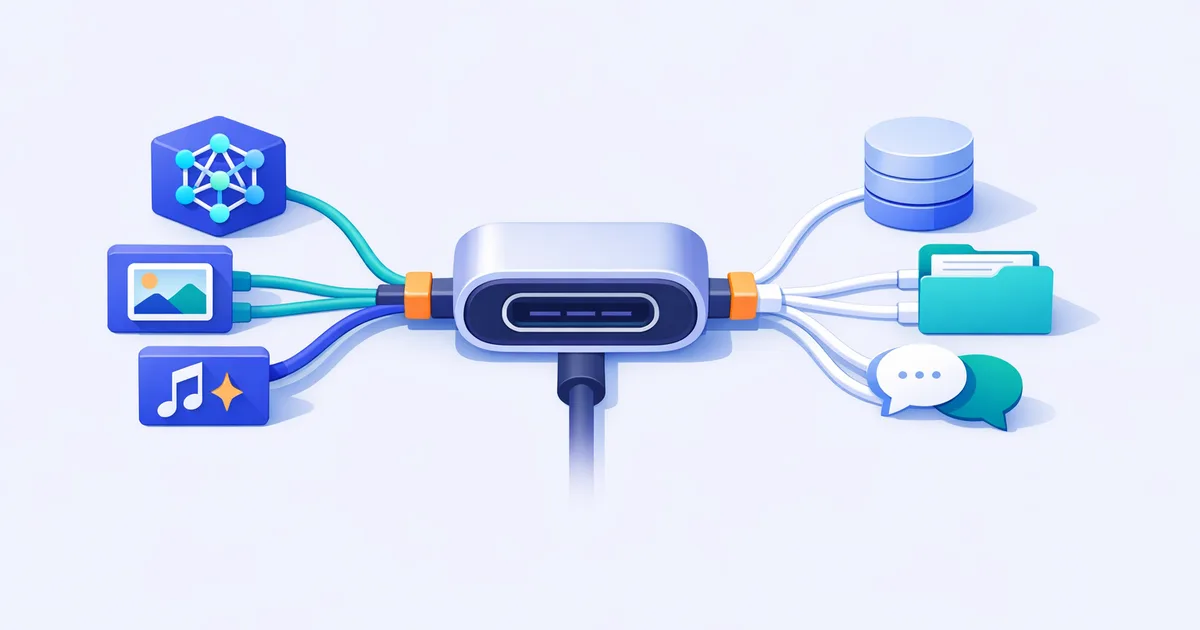
MCP (Model Context Protocol) is an open standard, introduced by Anthropic in November 2024, that lets AI assistants connect to external tools, files, and services through one common interface. Instead of a custom integration for every app, MCP gives the AI a single, shared way to plug in — often called "USB-C for AI."
If you’ve used an AI assistant and wished it could read your actual files, check your GitHub issues, or query your database instead of guessing, you’ve run into the gap MCP is built to close. On its own, a chatbot is sealed off from your world. MCP is the standard that lets it reach out — safely and predictably — to the tools you already use.
MCP in plain terms
Think about how laptops used to ship with a different port for every accessory: one for the monitor, one for power, one for the mouse. Then USB-C arrived — one shape that handles all of them. MCP does the same thing for AI.
Before MCP, every connection between an AI app and an outside tool was custom-built. If you wanted Claude to read your Notion docs, someone wrote a one-off integration. Want it to read Slack too? Another one. MCP replaces those one-offs with a single, shared interface. Build the connector once, and any AI app that speaks MCP can use it.
That’s why people call it “USB-C for AI” — one port, many tools (Anthropic, 2024).
Where MCP came from
Anthropic introduced and open-sourced MCP in November 2024, releasing the spec along with SDKs for Python and TypeScript (Anthropic, 2024). It borrows ideas from the Language Server Protocol — the standard that lets one code editor support many programming languages — and runs on the well-known JSON-RPC message format.
It spread quickly. OpenAI added MCP support across its Agents SDK and ChatGPT in early 2025, and Google confirmed support in Gemini soon after (Wikipedia, 2026). By late 2025 there were more than 10,000 public MCP servers, and Anthropic handed governance to the Linux Foundation’s Agentic AI Foundation — co-founded with Block and OpenAI — so no single company controls the standard (Anthropic, 2025).
The problem MCP solves: M×N becomes M+N
Here’s the math that makes MCP useful.
Imagine you have M AI apps (Claude, ChatGPT, Cursor) and N tools you want them to reach (GitHub, your database, Slack, Google Drive). Without a standard, each app needs its own custom connector for each tool. That’s M × N integrations to build and maintain — and the number explodes as either side grows.
With MCP, each AI app learns the protocol once, and each tool exposes itself through the protocol once. Now any app can talk to any tool. You’ve gone from M × N to M + N (Anthropic, 2024).
| Before MCP | With MCP | |
|---|---|---|
| Connections to build | M × N (one per pair) | M + N (one per app, one per tool) |
| Adding a new tool | Rebuild for every AI app | Build one MCP server; all apps get it |
| Who maintains it | Each app team, separately | The tool’s maintainer, once |
| Result | Fragmented, brittle | Shared, reusable |
How MCP works, step by step
MCP has two sides that talk to each other:
- The host and client. The host is the AI app you’re using — Claude Desktop, Cursor, ChatGPT. Inside it sits an MCP client that knows how to speak the protocol and manage connections.
- The MCP server. This is a small program that wraps a tool, data source, or service and exposes it in the MCP format. A GitHub server, a filesystem server, a Postgres server — each one is separate.
When they connect, the server advertises what it offers in three categories:
- Tools — actions the AI can take, like “create a GitHub issue” or “run this query.”
- Resources — data the AI can read, like files, database rows, or documents.
- Prompts — reusable prompt templates the server provides for common tasks.
The AI sees this menu, decides what it needs to answer your request, and the client calls it. The result comes back, and the model uses it to respond. You stay in control: most hosts ask for your approval before an action runs.
Real examples you can picture
MCP gets concrete fast once you see what people connect:
- Your files. Point an AI assistant at a folder so it can read and summarize your local documents without you pasting them in.
- GitHub. Let the assistant list open issues, read a pull request, or open a new issue — straight from the chat.
- A database. Ask plain-English questions and have the AI run read-only queries against your Postgres or SQLite data.
- Slack. Pull recent messages from a channel so the AI can draft a summary or a reply.
- Cursor and other editors. Cursor supports MCP, so the same servers you use with Claude also work inside your code editor.
You set these up once, and they’re available whenever you need them.
Why MCP matters for AI agents
A chatbot answers questions. An AI agent takes actions toward a goal — and to act in the real world, it needs hands. MCP gives it those hands in a consistent way.
Without a standard, every agent builder reinvents the same connectors. With MCP, an agent can discover available tools at runtime, pick the right one, and use it — whether that’s filing a ticket, checking a calendar, or updating a record. That’s why MCP shows up so often in agent frameworks and no-code automation; if you’re building an agent in n8n, MCP servers are a clean way to give it real capabilities.
MCP also pairs naturally with RAG. RAG focuses on reading relevant data to ground an answer; MCP gives the model a standard way to both read data and take actions. Many real systems use both.
Limits and security to keep in mind
MCP is genuinely useful, but it isn’t magic, and it deserves a careful setup:
- MCP is only a protocol. It defines how apps and tools talk. It doesn’t make the AI smarter or guarantee good behavior on its own.
- You’re trusting the servers. An MCP server runs real code and can touch real data. Install only servers you trust, and read what tools and permissions they request.
- Permissions matter. Give a server the narrowest access that does the job — read-only where possible, scoped tokens, no blanket admin rights.
- Prompt injection is a real risk. If an AI reads untrusted content through MCP, that content could try to trick it into taking unwanted actions. Keep approvals on for sensitive operations.
- It’s still maturing. The standard and its servers are evolving quickly, so expect rough edges and frequent updates.
Treat MCP like any powerful integration: convenient, but worth setting up with a clear head about what it can reach.
The bottom line
MCP is the plumbing that lets AI assistants connect to your real tools through one shared standard instead of a tangle of custom integrations. It turns M × N into M + N, it’s backed by Anthropic, OpenAI, Google, and the Linux Foundation, and it’s the reason agents can actually do things. You don’t need to build a server to benefit — most popular AI apps already speak MCP, so you can start by connecting one you trust.
Want more plain-English AI explainers like this one? Browse the Learn hub, and subscribe to get new guides as we publish them.
Frequently asked questions
What does MCP stand for? MCP stands for Model Context Protocol — an open standard that lets AI assistants connect to external tools, data, and services through one shared interface instead of many custom integrations.
Who created MCP? Anthropic introduced and open-sourced MCP in November 2024. It was later adopted by OpenAI, Google, and many code editors. In December 2025 Anthropic donated it to the Linux Foundation’s Agentic AI Foundation for neutral governance.
Why is MCP called USB-C for AI? Like USB-C, MCP is one standard port that many devices share. Any AI app that speaks MCP can connect to any MCP server, so you don’t need a different cable — a different custom integration — for every tool.
What problem does MCP solve? Without a standard, connecting M AI apps to N tools means building M times N custom integrations. MCP turns that into M plus N: each app and each tool speaks MCP once, and they all interoperate.
What is an MCP server? An MCP server is a small program that exposes a tool, data source, or service — like GitHub, a database, or your files — in the MCP format. AI apps (the clients) discover and call what the server offers.
Does Cursor support MCP? Yes. Cursor, Claude, ChatGPT, VS Code, GitHub Copilot, and Gemini all support MCP, so you can connect the same MCP servers across many of these tools.
Is MCP safe to use? MCP itself is just a protocol. Safety depends on the servers you connect and the permissions you grant. Only install MCP servers you trust, review what tools they expose, and limit access to sensitive systems.
Frequently asked questions
What does MCP stand for?
MCP stands for Model Context Protocol — an open standard that lets AI assistants connect to external tools, data, and services through one shared interface instead of many custom integrations.
Who created MCP?
Anthropic introduced and open-sourced MCP in November 2024. It was later adopted by OpenAI, Google, and many code editors. In December 2025 Anthropic donated it to the Linux Foundation's Agentic AI Foundation for neutral governance.
Why is MCP called USB-C for AI?
Like USB-C, MCP is one standard port that many devices share. Any AI app that speaks MCP can connect to any MCP server, so you don't need a different cable — a different custom integration — for every tool.
What problem does MCP solve?
Without a standard, connecting M AI apps to N tools means building M times N custom integrations. MCP turns that into M plus N: each app and each tool speaks MCP once, and they all interoperate.
What is an MCP server?
An MCP server is a small program that exposes a tool, data source, or service — like GitHub, a database, or your files — in the MCP format. AI apps (the clients) discover and call what the server offers.
Does Cursor support MCP?
Yes. Cursor, Claude, ChatGPT, VS Code, GitHub Copilot, and Gemini all support MCP, so you can connect the same MCP servers across many of these tools.
Is MCP safe to use?
MCP itself is just a protocol. Safety depends on the servers you connect and the permissions you grant. Only install MCP servers you trust, review what tools they expose, and limit access to sensitive systems.
Keep reading

Get good at AI — one practical email a week.
Tools, use cases, and shortcuts you can actually apply. No hype.